
Insights

When Patient Decisions Influence Outcomes, What Makes Data Relevant?
Data quality tells us whether information can be trusted. Data relevance asks a different question: whether that information adequately represents the outcome we are trying to understand. Clinical development is entering a more demanding phase of AI adoption. The question is no longer confined to what a technology can do in a controlled pilot. Organizations
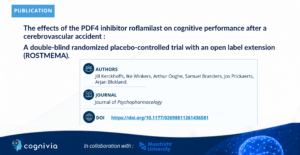
Clarifying Treatment Effects Through Prognostic Adjustment
This page provides an interpretation of a clinical study evaluating roflumilast in post-stroke cognitive impairment. For the full scientific details including study design, statistical approach, and complete results you can refer to the original publication: 👉 View the full scientific publication and abstract Study Context The study, conducted by the team of Prof. Harry Blokland at

Why Better Data Now Matters More Than Better Tools
There comes a moment in every industry when the conversation subtly shifts. Not because a single breakthrough changes everything, but because long‑standing concerns finally converge into a shared understanding: current approaches are no longer sufficient. That inflection point was clearly visible during the recent Fortrea Innovation & Technology Summit in Boston. Across panels, workshops, and
The Behavioral Layer: An Overlooked Determinant of Clinical Success
Clinical research continues to evolve at an impressive pace. Digital technologies streamline data capture, biomarkers deepen biological insight, and innovative trial designs broaden access for diverse populations. These advances have unquestionably accelerated development and expanded participant reach. Still, across all this progress, one dimension consistently shapes outcomes yet remains underrepresented in planning, modeling, and oversight: patient behavior. Behavioral factors like motivation,
Discussion on the Use of Placebell and FDA’s Feedback
Cognivia recently initiated a discussion with the FDA through the “Innovative Science and Technology Approaches for New Drugs (ISTAND) Pilot Program” process. A Letter of Intent (LOI) was submitted outlining Placebell’s methodology and seeking to explore Placebell’s applicability within the ISTAND for a wide range of statistical models. In response to the LOI, the FDA acknowledged that Placebell operates as

Disruptive Technology Without the Disruption
Implementing an innovative technology within a clinical trial is about much, much more than the technology – and while the tech might be “disruptive,” its actual implementation shouldn’t be. Failing to anticipate and plan for operational challenges is something that has hobbled the growth of many truly innovative tech companies’ – especially those that assumed